.jpg)
Understanding Orifice Sizing for Polyurethane Processing Equipment
Updated: May 15
The Importance of Orifice Sizing
Orifice sizing is vital for achieving the best mix quality of two-part polyurethane foam in a Reaction Injection Molding (RIM) operation. Several factors influence the overall injection pressure of your system, and the orifice is the final point before mixing takes place.
Each polyurethane chemical supplier provides a datasheet detailing the ideal injection pressure for your specific chemistry. Other critical considerations include the chemical temperature and mold temperature.
Factors Contributing to Injection Pressure
The factors that contribute to injection pressure include:
Chemistry Properties
- Viscosity at Temperature
- Density
Desired Chemical Mass Flow Rate
Orifice Size
A Word of Caution - False Pressure Readings
In most RIM systems, the chemical pressure is monitored upstream from the mixing head. It’s crucial to understand that the pressure sensor measures the total system pressure. This includes everything upstream from the sensor, such as hoses, valves, flowmeters, fittings, and filters. Any restriction upstream from the sensor will create its own back pressure.
When observing your measured injection pressures, keep in mind that undesired restrictions can lead to false injection pressure readings.
Verifying Back Pressure
To verify minimal or no undesired back pressure, remove the orifice from the orifice assembly in your mix head and replace the orifice assembly. Once you switch the machine to high-pressure circulation, you can check if back pressure is created by something in your system. If the pressures are the same as, or close to, the pressures during low-pressure circulation, you can be confident that the system is not causing false readings. This indicates you are receiving the true pressure reading at the orifice.
Determining Proper Orifice Sizing
To calculate the ideal orifice size, we will use the Bernoulli-based orifice sizing equation. This equation is somewhat complex.
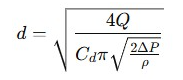
Inputs for the Equation
The inputs for this equation are:
Q = Desired flow rate (grams/sec, lbs/min)
Cd = Discharge coefficient, incorporating viscosity
p = Fluid density (grams/CC)
P = Desired injection pressure (PSI)
Using these variables, you can calculate the correct orifice diameter.
Since nuances can influence the final calculated amount, MHR has developed an Orifice Calculator. This tool quickly accepts the inputs listed above and outputs the required orifice diameter. Contact us today with your process inputs, and we’ll provide the correct orifice sizing for your application.
Signs Your Orifice is the Wrong Size
1. Pressure Setting is Difficult to Maintain
An improperly sized orifice can make it challenging to maintain your desired injection pressures. You may notice that the pressure setting is "touchy," where even slight adjustments to the adjuster screw cause large swings in the injection pressure readings. Ideally, you should be able to adjust your injection pressures to within 10-15 psi of your desired target without much trouble.
2. Foam Quality and Mix Issues
Several signs indicate that an improperly sized orifice is causing mix issues. If you are having trouble diagnosing foam quality, it’s best practice to evaluate your orifice sizing.
Some examples include:
"Streaking" or "Swirls" where the components are not mixed properly.
Soft Spots
Large or Uneven Bubbles/Uneven Cell Structure
Voids/Unfilled Areas
Surface Defects
3. Pressure Setting Cannot be Achieved
You may find that you cannot achieve a low enough pressure, indicating an orifice that is too small. Conversely, if you cannot achieve a high enough pressure, your orifice may be too large.
Additional Considerations for Orifice Sizing
The Role of Temperature
Temperature significantly affects the viscosity and density of the chemicals used in your RIM process. Higher temperatures generally reduce viscosity, allowing for easier flow through the orifice. However, this can also lead to increased pressure if not managed correctly. Always consider the temperature of both the chemicals and the mold when determining orifice size.
The Impact of Flow Rate
The desired flow rate is another critical factor in orifice sizing. A higher flow rate requires a larger orifice to maintain the necessary injection pressure. Conversely, if the flow rate is too low, it may indicate that the orifice is too small, which can lead to increased pressure and potential quality issues.
Regular Maintenance and Inspection
Regular maintenance and inspection of your RIM system can help prevent issues related to orifice sizing. Ensure that all components, including hoses and valves, are free from blockages or wear. This will help maintain accurate pressure readings and improve overall system performance.
Conclusion: Mastering Orifice Sizing
Getting your RIM process dialed in can be frustrating at times. Even slight changes to chemistry, the environment, and process equipment can affect foam quality and the reliability of your equipment. Verifying your orifice size is just one item that can make all the difference in a reliable, high-quality operation.
By understanding the importance of orifice sizing and the factors that influence it, you can ensure optimal performance of your polyurethane processing equipment. Remember, a change of just 0.2mm can make all the difference.
Final Thoughts
In summary, mastering orifice sizing is essential for ensuring the efficiency and effectiveness of your polyurethane processing equipment. By paying attention to the factors discussed, you can enhance your operations and achieve the desired results.


Comments